
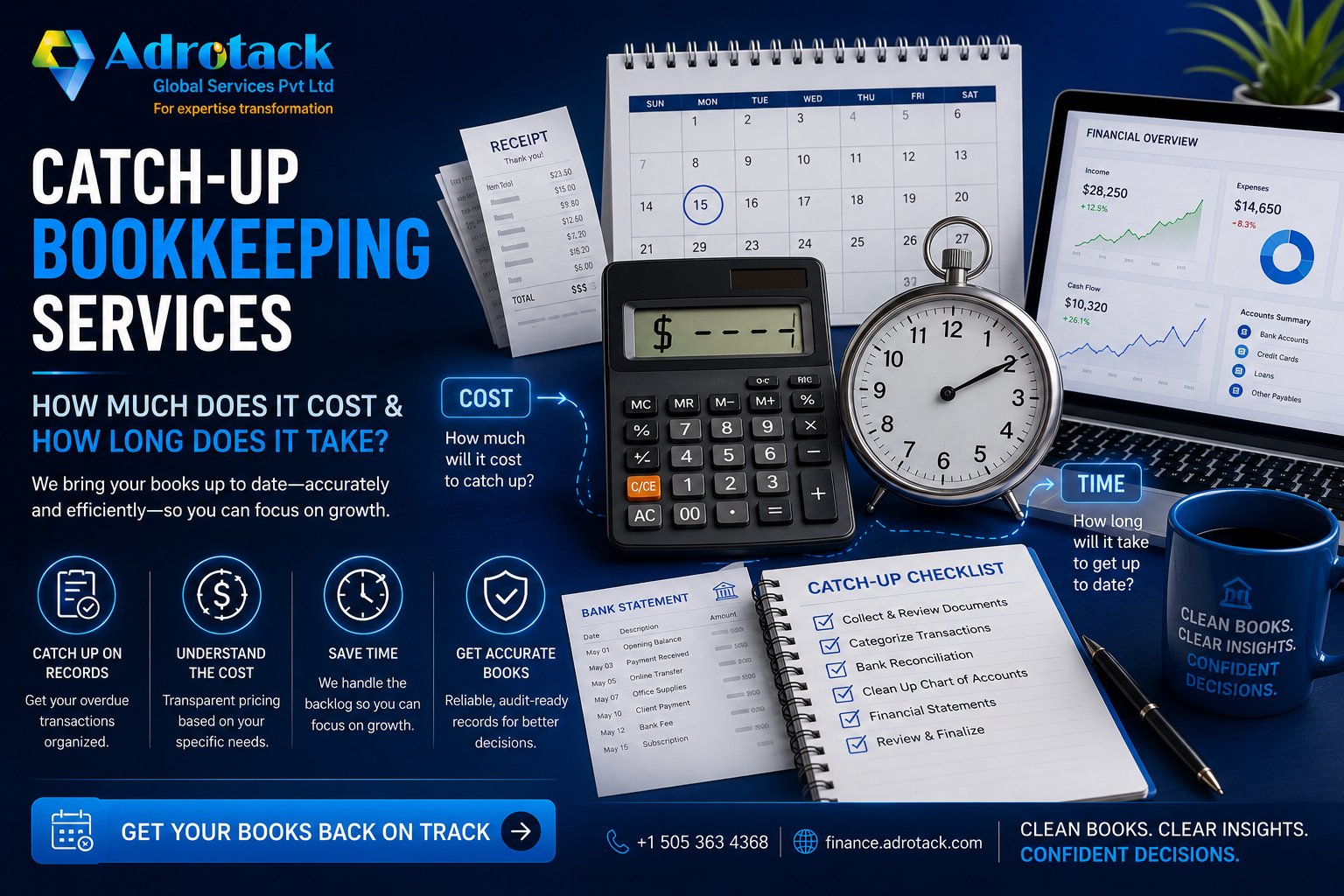
Catch-Up Bookkeeping Services: How Much Does It Cost & How Long Does It Take?
If your bank feeds haven’t been reconciled in months, your chart of accounts is a mess, or you’re not sure what your business actually made last quarter, you’re not alone. Falling behind on the books happens to startups juggling too many priorities, small businesses that lost a bookkeeper, and even established companies going through a busy growth stretch. The fix is usually catch-up bookkeeping services — a focused project to bring your financial records up to date so you can move forward with accurate numbers.
Catch-Up Bookkeeping Services: How Much Does It Cost & How Long Does It Take?
What Is Catch-Up Bookkeeping?
This guide breaks down what catch-up bookkeeping actually involves, what it typically costs, how long it tends to take, and how to think about choosing a provider. Because pricing and timelines depend heavily on the specifics of your business, we’ll focus on ranges and the factors that move them, rather than one-size-fits-all numbers.
Catch-up bookkeeping is the process of bringing overdue or incomplete financial records current — typically covering everything from your last accurate close up through today. It’s a project-based service, distinct from the ongoing monthly work a bookkeeper normally does.
A catch-up engagement generally involves:
Downloading and reviewing missed bank and credit card statements
Categorizing transactions that were never entered
Reconciling accounts against actual bank and card activity
Correcting miscategorized or duplicate entries
Reviewing and adjusting opening balances
Producing accurate financial statements for the overdue period
The goal is simple: by the end of the engagement, your books should reflect what actually happened in your business, month by month, and be ready to hand off to a tax preparer or an ongoing bookkeeper.
It’s worth noting that “catch-up bookkeeping” and “bookkeeping cleanup” are often used interchangeably, but they aren’t always the same thing. We’ll cover that distinction later in this article.
When Does a Business Need Catch-Up Bookkeeping?
Businesses fall behind on bookkeeping for a wide range of reasons, and it’s rarely a sign of anything more than being busy. Common situations include:
A bookkeeper or accountant left and the books haven’t been touched since
A DIY approach stalled out — the owner was doing it in spreadsheets or software but fell behind
Rapid growth outpaced the existing process, with transaction volume increasing faster than the bookkeeping could keep up
Tax season is approaching and the books aren’t ready for a CPA
A loan, investor, or acquisition requires accurate, current financial statements
Multiple bank accounts or entities were added without a matching update to the bookkeeping process
Sales tax or payroll filings are due and the underlying numbers aren’t reliable
If any of these sound familiar, catch-up bookkeeping is generally the right starting point before resuming (or starting) monthly bookkeeping.
How Much Does Catch-Up Bookkeeping Cost?
There’s no single number that applies to every business, because catch-up bookkeeping cost depends on how much work is actually involved — not just how many months are overdue. That said, most engagements fall somewhere between a few hundred dollars for a very simple, short backlog and several thousand dollars for a complex, multi-year, multi-entity catch-up.
The best way to think about catch-up bookkeeping pricing is as a function of effort: the more transactions, accounts, and complications involved, the more time it takes a bookkeeper to get everything accurate.


What Affects Catch-Up Bookkeeping Cost?
Number of overdue months. More months generally means more transactions to review, categorize, and reconcile — though a high-volume single month can sometimes take longer than several quiet months combined.
Transaction volume. A business with dozens of transactions a month costs less to catch up than one with hundreds or thousands, regardless of how many months are involved.
Number of bank and credit-card accounts. Each additional account adds statements to pull, transactions to categorize, and reconciliations to complete.
Number of business entities. Multi-entity businesses — holding companies, franchises, or businesses with separate LLCs for different locations or lines of business — require separate books for each entity, which increases scope.
Payroll. Businesses with employees need payroll transactions correctly recorded and reconciled against payroll reports, which adds a layer of complexity compared to businesses with no payroll.
Inventory. Businesses that track inventory or cost of goods sold typically require additional review to make sure inventory-related accounts are accurate.
Accounts payable and accounts receivable. If the business tracks unpaid bills or outstanding customer invoices, catching up AP and AR accurately takes more time than simple cash-basis bookkeeping.
Sales tax. Businesses collecting and remitting sales tax need those transactions categorized correctly, and discrepancies often need to be identified and flagged.
Condition and accuracy of existing records. Books with major errors, duplicate entries, or a disorganized chart of accounts take longer to fix than books that are simply behind but were kept reasonably well before that point.
Accounting software. The platform in use — and whether it’s set up correctly — affects how efficiently a bookkeeper can work. Migrating from spreadsheets or switching software mid-catch-up adds time.
Cost Factor Lower Cost Impact Higher Cost Impact
Overdue months 1–3 months 12+ months
Transaction volume Low volume High volume
Bank/card accounts 1–2 accounts Multiple accounts
Entities Single entity Multiple entities
Payroll None Multiple employees
Inventory None Active inventory tracking
AP/AR Cash basis, minimal Active AP/AR management
Record condition Reasonably accurate Disorganized or erroneous
Catch-Up Bookkeeping Pricing Models
Providers generally price catch-up bookkeeping services using one of a few common approaches. None is inherently better — the right fit depends on how well-defined the scope is upfront.
Fixed project pricing. A flat rate for the full catch-up project, usually quoted after a review of bank statements, transaction volume, and account complexity. This gives businesses cost certainty, which is why it’s a common approach for catch-up work.
Monthly pricing. Some providers price catch-up work per overdue month, particularly when the business’s monthly activity is fairly consistent. This makes it easier to estimate cost as the number of overdue months becomes clear.
Hourly pricing. Best suited to situations where the scope is hard to define in advance — for example, books in poor condition where the bookkeeper won’t know the full extent of the work until they’re in the records.
Custom pricing. For multi-entity businesses, businesses with inventory, or unusually complex situations, providers often build a custom quote that blends elements of the approaches above.
Many providers offer a free or low-cost initial review of your accounts before quoting, since it’s difficult to price catch-up bookkeeping accurately without seeing the actual state of the books.
A Practical Cost Example
The framework below is an illustrative example only — not a market-wide price list. Actual catch-up bookkeeping pricing varies by provider, region, and the specific condition of a business’s records.
Backlog Scenario Example Complexity Illustrative Cost Range
Simple 1–3 months behind, single entity, no payroll, one or two bank accounts, reasonably clean records Lower end of the range
Moderate 6–12 months behind, payroll, moderate transaction volume, a few accounts Mid-range
Complex 1+ years behind, multiple entities, payroll, inventory, disorganized records Higher end of the range
Treat this as a starting point for a conversation with a provider, not a quote. Ask any bookkeeping provider for a specific estimate based on your actual accounts.
This guide breaks down what catch-up bookkeeping actually involves, what it typically costs, how long it tends to take, and how to think about choosing a provider. Because pricing and timelines depend heavily on the specifics of your business, we’ll focus on ranges and the factors that move them, rather than one-size-fits-all numbers.
How Long Does Catch-Up Bookkeeping Take?
A business with a short backlog (roughly 1–3 months), low transaction volume, a single entity, and no payroll or inventory can often be caught up in about one to two weeks, depending on the provider’s availability and how quickly records can be gathered.
Moderate Bookkeeping Backlog
A business that’s 6–12 months behind, has payroll, moderate transaction volume, and a handful of bank or card accounts typically takes somewhere in the range of two to six weeks.
Complex or Multi-Entity Bookkeeping
Businesses that are more than a year behind, operate multiple entities, manage inventory, or have significantly disorganized records should generally expect a longer engagement — often six weeks to a few months, particularly if the bookkeeper needs to go back and forth with the business owner to resolve discrepancies.
In every case, how quickly a business can supply requested documents and answer questions has a direct effect on the actual timeline.
What Is Included in Catch-Up Bookkeeping Services?
A thorough catch-up bookkeeping engagement should go beyond simply entering transactions. Look for a provider that includes:
Transaction categorization — assigning every transaction to the correct account
Bank and credit-card reconciliation — matching recorded transactions to actual statements to confirm nothing is missing or duplicated
Chart-of-accounts review — checking that accounts are structured logically and consistently, and cleaning up categories that don’t make sense
Correcting bookkeeping errors — fixing miscategorized transactions, duplicate entries, and other mistakes found along the way
Opening balance review — confirming that beginning balances for each account are accurate before building the catch-up period on top of them
Financial statement review — checking that the resulting profit and loss statement and balance sheet are reasonable and internally consistent
Identifying missing transactions — flagging gaps where bank activity doesn’t match recorded transactions, so nothing falls through the cracks
Preparing books for ongoing monthly bookkeeping — leaving the books in a state where a bookkeeper can pick up cleanly going forward
If a provider’s catch-up service skips reconciliation or opening balance review, the resulting numbers may look complete without actually being accurate.
What Happens If Your Books Are Behind?
Letting bookkeeping fall behind creates problems that compound the longer they’re left unaddressed:
Inaccurate financial reports. Without current books, profit and loss statements and balance sheets don’t reflect reality, making it hard to know if the business is actually profitable.
Tax preparation problems. CPAs and tax preparers need accurate books to file returns correctly; incomplete records can lead to rushed, error-prone filings or extensions.
Poor cash-flow visibility. Without up-to-date records, it’s difficult to know how much cash is actually available, what’s owed, and what’s coming in.
Difficulty making business decisions. Hiring, pricing, and spending decisions all rely on knowing the real financial picture — decisions made on outdated or missing data carry more risk.
Missed deadlines. Sales tax filings, quarterly estimated payments, and loan covenants often depend on current, accurate financials.
None of this means a business is in serious trouble simply for falling behind — it’s a common and fixable situation. But the longer books stay out of date, the more time (and often cost) it takes to catch them up.
What Do You Need to Give Your Bookkeeper?
Before requesting a quote, gathering the following information will help a provider give you a more accurate estimate:
Bank and credit card statements for the overdue period
Access to your accounting software (or confirmation of which software you use, if any)
Payroll reports, if you have employees
A list of business bank accounts, credit cards, and loans
Prior financial statements, if any exist
Information about business entities, if you operate more than one
Sales tax filing history, if applicable
Any known issues or gaps you’re already aware of
The more complete this information is upfront, the more accurate a provider’s quote and timeline estimate will be.
How to Choose a Catch-Up Bookkeeping Service
A few things worth evaluating when comparing catch-up bookkeeping providers:


Do they review your records before quoting? A provider willing to look at your actual bank statements and transaction volume before pricing is generally giving you a more accurate estimate than one quoting blind.
Is reconciliation included, not just data entry? Categorizing transactions without reconciling accounts to actual statements leaves room for errors to go unnoticed.
Do they work with your accounting software? Confirm they’re familiar with the platform you use, or are willing to migrate your data if needed.
Do they explain what happens after catch-up is complete? A good provider should be clear about how the transition to ongoing monthly bookkeeping works.
Are they transparent about pricing and scope? Look for a clear explanation of what’s included, rather than vague or open-ended pricing.
Do they understand your industry’s specifics? Inventory, payroll, multi-entity structures, and sales tax requirements vary — experience with your type of business is a plus.
Outsourced catch-up bookkeeping is common for a reason: it lets a business owner hand off a time-consuming, detail-heavy project to someone who does this work regularly, rather than trying to fit it in alongside running the business.
When Should You Switch to Monthly Bookkeeping?
Once your catch-up bookkeeping project is complete, the natural next step is moving to ongoing monthly bookkeeping so the backlog doesn’t reappear. Signs it’s time to make that switch include:
You’ve just finished a catch-up project and want to keep the books current going forward
Tax season is a recurring source of stress because records are never ready in time
You’re making decisions without reliable, up-to-date numbers
Your transaction volume has grown to the point where occasional DIY updates aren’t sustainable
You’re preparing for a loan application, investment round, or eventual sale of the business
Moving directly from catch-up into monthly bookkeeping — often with the same provider — tends to be more efficient than starting the search for an ongoing bookkeeper from scratch once the catch-up work is done.
Frequently Asked Questions
How much does catch-up bookkeeping cost?
Cost depends on factors like how many months are overdue, transaction volume, number of accounts and entities, and whether payroll or inventory are involved. Simple backlogs typically cost less than complex, multi-entity situations. Most providers quote after reviewing your actual records.
How long does catch-up bookkeeping take?
Timelines generally range from about one to two weeks for a simple, short backlog to a few months for complex or multi-year, multi-entity situations. Actual timelines vary by provider and are not guaranteed until your specific records have been reviewed
Can a bookkeeper catch up several years of books?
Yes, multi-year catch-up projects are common, particularly for businesses that never had consistent bookkeeping in place. These projects typically take longer and involve more careful review, especially around opening balances and historical accuracy.
Is catch-up bookkeeping different from bookkeeping cleanup?
They’re related but not identical. Catch-up bookkeeping addresses missing or incomplete records for an overdue period, while bookkeeping cleanup fixes existing records that are inaccurate or disorganized, even if they’re technically up to date. Many engagements involve both.
Can catch-up bookkeeping help with tax preparation?
Yes. Accurate, current books make it easier for a CPA or tax preparer to file returns correctly and on time. Businesses often pursue catch-up bookkeeping specifically ahead of a tax deadline or extension.
What records do I need for catch-up bookkeeping?
At a minimum, bank and credit card statements for the overdue period, access to your accounting software, payroll reports if applicable, and information about your business entities and accounts. Providing complete records upfront leads to more accurate pricing and faster turnaround.
Can I switch to monthly bookkeeping after catch-up work?
Yes, this is a common and often recommended next step. Once your books are current, moving into ongoing monthly bookkeeping helps prevent another backlog from building up.
Conclusion
Falling behind on bookkeeping is a common problem, not a sign of failure — and it’s a solvable one. Catch-up bookkeeping services exist specifically to bring overdue records up to date, correct errors along the way, and set your business up for reliable ongoing bookkeeping. Cost and timelines depend on the specifics of your situation, from transaction volume to the number of entities you operate, so the most useful next step is usually a records review and a tailored quote rather than relying on a generic price.
Need to bring your books up to date? Adrotack Finance provides catch-up bookkeeping services for US businesses, helping organize overdue financial records and prepare your books for reliable ongoing bookkeeping.
This guide breaks down what catch-up bookkeeping actually involves, what it typically costs, how long it tends to take, and how to think about choosing a provider. Because pricing and timelines depend heavily on the specifics of your business, we’ll focus on ranges and the factors that move them, rather than one-size-fits-all numbers.