
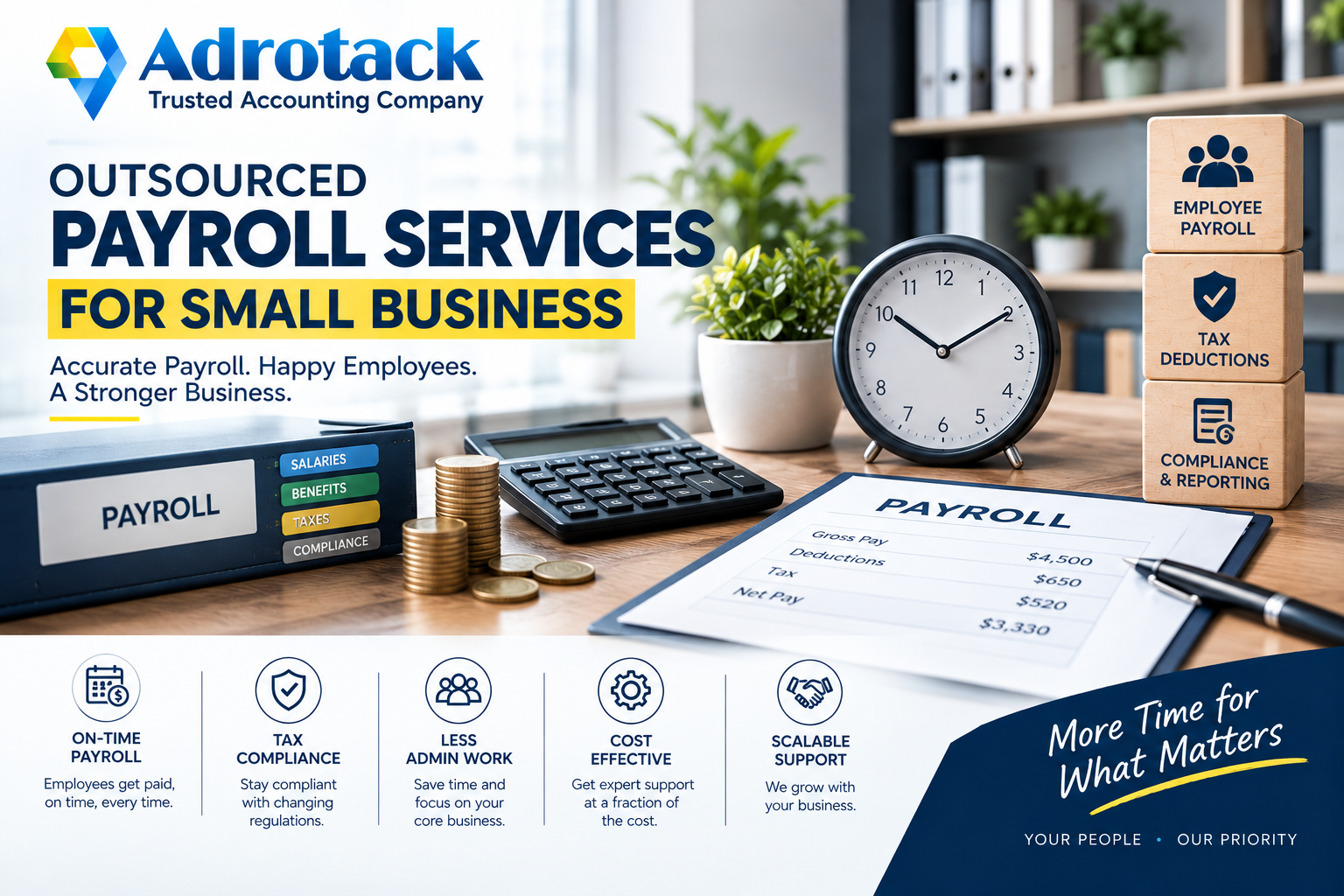
Outsourced Payroll Services for Small Business: Cost, Providers & What's Included in 2026
Payroll is more than transferring money to employees — it connects employee data, time records, wage calculations, deductions, tax deposits, filings, benefits, and year-end reporting. A late or incorrect run can affect employees immediately and expose the employer to notices or penalties. Outsourcing payroll can reduce administrative burden, but it doesn’t remove the employer’s responsibility to oversee the process. Here’s what outsourced payroll typically costs in 2026, what it should include, and how to choose a provider.
Average Cost of Outsourced Payroll in 2026
Payroll pricing is typically structured as a base fee plus a per-employee charge:
- Base monthly fee: commonly $30–$150, depending on provider and included features
- Per-employee fee: commonly $4–$15 per employee, per pay period
- Additional costs: implementation/setup fees, multi-state filing fees, year-end form processing (W-2/1099), off-cycle payroll runs, and amended-return handling
A small business with 10 employees on a biweekly pay schedule, for example, might land somewhere in the low-to-mid hundreds of dollars per month once base and per-employee fees are combined — but the exact figure depends heavily on the provider and scope, so treat this as a planning range rather than a quote.
What Affects Outsourced Payroll Pricing?
- Number of employees and pay frequency (weekly, biweekly, semi-monthly)
- Number of states and localities where employees work
- Contractor payments (1099) in addition to W-2 employees
- Off-cycle or same-day payroll runs
- Benefits administration and timekeeping integrations
- Year-end forms (W-2, 1099) and amended-return support
- Whether the provider is filing as a reporting agent or handling administrative processing only
What's Included in Outsourced Payroll Services
A typical outsourced payroll engagement can include:
- Employee setup and onboarding
- Earnings and deduction calculations
- Direct-deposit file processing
- Payroll registers and reports
- Federal and state tax filing support
- Year-end forms (W-2s, 1099s)
- Garnishment processing
- Payroll journal entries for your books
Some providers also coordinate benefits, time tracking, workers’ compensation data, and multi-state registrations. Always confirm exactly which of these are included at your pricing tier versus billed separately.
Outsourced Payroll vs. In-House Payroll
An in-house payroll setup typically involves the employer managing payroll internally using staff time and payroll software. The cost structure generally includes employee salary or staff time costs along with a payroll software subscription. With an outsourced payroll service, businesses typically pay a base fee plus a per-employee fee.
For tax filing responsibilities, an in-house payroll team manages filings directly. With an outsourced payroll provider, the provider may handle tax filings, but the employer generally retains oversight responsibility depending on the arrangement.
Multi-state payroll can be more complex for businesses operating across different states. An in-house payroll team may need internal expertise for each state, while multi-state capabilities are often incorporated into an outsourced payroll provider’s services.
In terms of error and compliance risk, an in-house payroll process can concentrate responsibility with one internal employee. Outsourcing can distribute responsibilities between the business and provider, but it does not eliminate risk. Employers should still review payroll information and verify important filings and payments.
For very small businesses with few employees, a single state, and a simple pay structure, in-house payroll may be a suitable option. Growing businesses with increasing headcount, employees in multiple states, or limited internal payroll expertise may benefit more from an outsourced payroll service.
Important Compliance Note
The IRS advises employers to choose third-party payroll providers carefully. Depending on the arrangement, the employer may retain certain tax responsibilities even when payroll is outsourced. Businesses should maintain access to their own tax accounts and verify tax deposits and filings rather than relying solely on information shown in a payroll provider’s dashboard.
Types of Payroll Providers
Payroll software (self-service) allows you to run payroll yourself using payroll software. This option is generally best for very small businesses that are comfortable managing payroll processes internally.
A full-service payroll company handles payroll processing and may file payroll taxes on your behalf. This can be a good fit for small-to-mid-sized businesses that want a more hands-off payroll process.
A PEO (Professional Employer Organization) operates under a co-employment model and typically bundles payroll, employee benefits, and HR services. This option is best suited for businesses that want integrated HR, payroll, and benefits support.
An accounting or bookkeeping firm with a payroll add-on integrates payroll services with existing bookkeeping and accounting work. This can be useful for businesses that prefer to have their payroll and accounting records managed by one team.
Controls Every Employer Should Keep — Even When Outsourcing
- Separate the roles of preparing and approving payroll
- Review the payroll register before release each period
- Compare each run’s total against the prior period
- Inspect new hires, terminations, and unusual bonuses or deductions
- Reconcile payroll clearing and tax-liability accounts after each run
- Maintain your own access to federal and state tax accounts to verify deposits
Provider-Selection Checklist
Before signing with a payroll provider, ask:
- Which states and localities are supported?
- How are tax notices handled if one arrives?
- What are the implementation timeline and data requirements?
- What integrations exist with your accounting, timekeeping, and HR systems?
- What is the fee for off-cycle runs, amended returns, or additional state registrations?
- How is employee data secured?
- What happens to historical records if you switch providers later?
When Outsourcing Payroll Makes Sense
Outsourcing is typically a strong fit when:
Payroll is consuming significant management time
The business is expanding into new states
Employee count is growing and pay complexity is increasing
Payroll knowledge currently sits with only one internal person
Recurring payroll errors are affecting employee or management confidence
Frequently Asked Questions
How much does outsourced payroll cost for a small business? Typically a base monthly fee of $30–$150 plus $4–$15 per employee per pay period, depending on the provider, states involved, and included services. Request a scoped quote for an accurate number.
Does outsourcing payroll remove employer liability? Not automatically. Responsibility depends on the specific legal arrangement. The IRS advises employers to choose third-party payroll providers carefully and to maintain oversight, including verifying tax deposits and filings.
Can a payroll provider handle multiple states? Many can, but confirm registration, withholding, unemployment, and local-tax handling for every state where you have employees before assuming full coverage.
What’s included in a typical outsourced payroll service? Employee setup, earnings/deduction calculations, direct deposit, tax filing support, year-end forms, and payroll journal entries. Benefits administration and multi-state registration are often add-ons — confirm what’s included at your tier.
How long does payroll implementation take? Timing depends on employee data readiness, prior payroll history, state tax account setup, integrations, and your chosen cutover date — ask your provider for a specific timeline.
Is a PEO the same as outsourced payroll? No. A PEO uses a co-employment model that typically bundles payroll with HR and benefits administration, while a standalone payroll provider focuses on processing and tax filing only.
What happens if my payroll provider makes an error? Ask upfront how error correction and amended filings are handled, and whether related penalty or interest costs are covered by the provider or the employer.
Can I switch payroll providers mid-year? Yes, but it requires careful data migration and coordination on tax filings for the transition period — plan the cutover with both the old and new provider involved.
Do outsourced payroll services handle contractor (1099) payments? Many do, but confirm this explicitly, since some providers price W-2 and 1099 payment processing separately.
Is outsourced payroll worth it for a very small business (1–5 employees)? It can be, especially if payroll tax compliance is unfamiliar territory or you want to avoid manual calculation errors — but self-service payroll software may be more cost-effective at very small scale. Compare both options against your actual time cost.
Conclusion
Outsourced payroll pricing is straightforward in structure — a base fee plus a per-employee charge — but the real comparison point is scope: which states are covered, what’s included versus billed separately, and how tax-filing responsibility is shared. Confirm your actual employee count, states, and required services, then request a scoped quote from a provider so you’re comparing equivalent offers.